When we are talking about Information Society or, as Manuel Castells puts it the Information Age, we are apt to pronounce the positive sides, advantages, and acquirements of this global development. That information and knowledge are central objects and means of power exertion, governance and domination often is neglected or at least not explicitly articulated in public discourses. But from various thinkers, e.g. Michel Foucault, we know that power and knowledge can form complexes, information can become knowledge that is used for domination. The distinction between codifiable and non-codifiable knowledge can constitute forms of domination and the access to information can cause new forms of social stratification and marginalization. The so called digital divide separating the older, less educated and more traditional parts of society from the more progressive, higher educated and younger rest is just one example. To develop an Analytics of these power relations that constitute the information society in various ways, a re-lecture of Jean-Francois Lyotard, Michel Foucault and jean Baudrillard together with newer approaches as Manuel Castells’ seminal work can be helpful.
The particular importance of information and knowledge for postmodern societies has been analyzed in different ways. In “The Postmodern Condition: A report on knowledge”, Jean Francois Lyotard argues that information processable in binary code receives special appreciation in the age of digitalization. This affects all information that can be represented by sequences of Zeros and Ones (00101000111). In other words: only this kind of information can be processed and analyzed by computers, what is of main importance in times of enormous data flow rates. As this encoding is not possible for all kinds of information, some forms of information and knowledge – and with them the bearer or carrier – are discriminated against. This process of selection and hegemonialization of digitally processable information and knowledge tends to banalize information beyond this boundary. They are excepted from the digital discourse.
New parallel information societies with their own specific rules and codes emerge through these mechanisms of selection. We can argue with Michel Foucault that new “orders of the discourse” emerge, that compete for access to power and domination, and to politics.
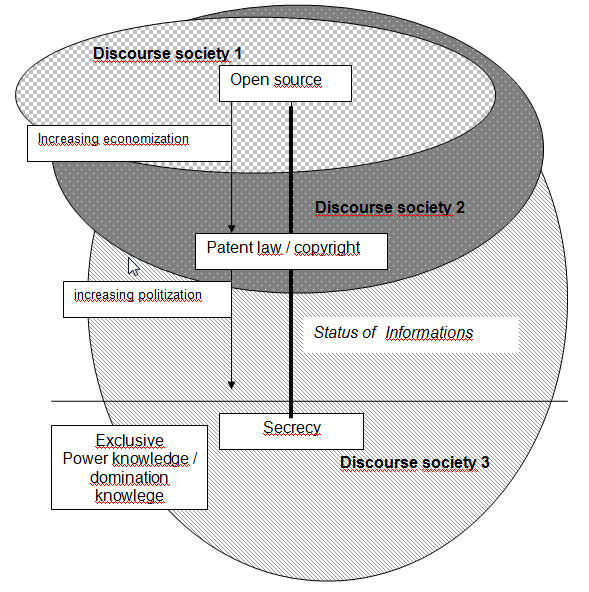
Discourses are amongst other things characterized by the access to information with different status: open source, being subject to patent law or copyright, declared as top secret. The latter can be called exclusive domination-knowledge. In this context, a capitalism of information emerges and a new meta-narrative takes form around the paradox myth of information stating that strength and innovation arise from information and knowledge. As a consequence information should be particularly protected and at the same time access should be kept as free as possible. The latter often refers to information that are neither relevant for business nor for security. Within an economy of information, no one profiting economically from informationn can be interested in a total freedom of information. On the other hand, new subcultures and information producers form up around banalized and seemingly irrelevant and therefor open source and freely accessible information and knowledge (This means the emergence of a new economy of information, indeed). New constellations of emitter/dispatcher, media, and receiver/recipient with totally new logics can be observed, as for example Web 2.0 shows. That these developments abet Baudrillard’s thesis of the denouement of realities is another chapter of another story.
Another important point seems to be the exponentially growing production rate of information. This point evokes different interpretations: First, that reality itself disappears with the flood of informations and the dissolution of the difference between emitter and recipient, message and medium. Reality is transformed into simulations, as Jean Baudrillard would have put it. He describes this information society as follows: „Such is the last stage of the social relation, ours, which is no longer one of persuasion (…) but one of deterrence: `YOU are information, you are the social, you are the event, you are involved, you have the word etc`.“. Und weiter: „No more subject, no more focal point, no more center or periphery: pure flexion or circular inflexion“ (Baudrillard 1994:29). Second, there is an idea of global control and “empowerment, on the basis of globally available masses of information. This discussion encompasses the work of Michel Foucault in “discipline and punish” and Jeremy Bentham’s “Panopticon” as well as the newer work on Security and Risk, and the Surveillance Studies.
It seems to be necessary to develop the dimensions of an Analytics of Information Society according to these roughly specified approaches. Within the framework of a political economy of Information, these dimensions are relevant for a study of power relations and domination within information society on the levels of society, of information and on a processual level. On the societal level this would include 1) social control vs. social dissolution; 2 simulation vs. reality of identity; 3) integration vs. exclusion in discourse societies. On the processual level this would mean to analyze communication in terms of 4) emitter vs. recipient, and 5) liberty vs. limitation. Last but not least this would include the dimensions 6) binary codes vs. narratives; 7) relevance vs. irrelevance; 8 ) economic vs. non-economic usability and 9) security contents on the informational level.
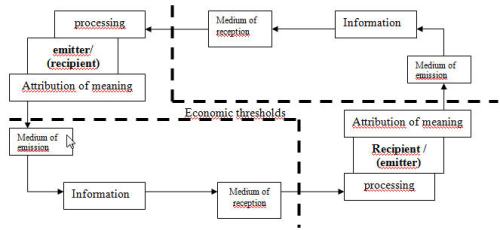
Starting from these dimensions, various models of an analytics of information society emerge. They can be used on different levels or can link the dimensions with each others. For example, economic thresholds can prevent emitters from emitting and recipients from receiving (costs for internet or licenses, copyright etc.). Though, there has to be made an economic decision, whether and if, which, resources are used for one or another information and which results are expected. This is especially relevant for political decision making, governance and leadership.
Chart 1: the economization of informational exchange
Over the categorization of various informations and the simultaneous economization and politization a double hierarchization of knowledge and information emerges: economically, i.e. patent law and copyright and the trading of information and licenses, that are by far not affordable for all; politically through the classification of knowledge as relevant for security, top secret etc. This hierarchization of information then causes a hierarchization of discourses and discourse societies as information is availabe to different degrees (how can I argue against the use of nuclear weapons or energy without results of clinical studies showing the impacts of radiation?). At the same time this can mean that power discourses are cut off from relevant information as information from subcultures or alternative ways of communication cannot be processed.
Chart 2: Figuration of Discourse societies
 <!–[if !mso]> <! st1\:*{behavior:url(#ieooui) } –>
Related Reading:
- Baudrillard J (1983) Simulations. New York: Semiotext(e).
- Baudrillard J (1994) Simulacra and Simulation. Translated by Sheila Faria Glaser. Ann Arbor: University of Michigan Press
- Baudrillard, Jean; Glaser, Sheila Faria (2006): Simulacra and simulation. 15. Druck. Ann Arbor: University of Michigan Press.
- Bell, Daniel 1973: The coming of post-industrial society. A venture in social forecasting”, New York, NY
- Burchell, Graham; Foucault, Michel (2007): The Foucault effect. Studies in governmentality ; with two lectures by and an interview with Michel Foucault. [Nachdr.]. Chicago, Ill.: Univ. of Chicago Press.
- Castells, Manuel (2006): End of millenium. 2. ed., [New. ed., Nachdr.]. Malden, Mass.: Blackwell (The information age, Vol. 3).
- Castells, Manuel (2006): The power of identity. 2. ed., new ed. reprint. Cambridge, Mass.: Blackwell (The information age, Vol. 2).
- Castells, Manuel (2008): The rise of the network society. 2. ed., new ed., [Nachdr.]. Malden, MA: Blackwell (The information age, Vol. 1).
- de la Mothe, John/Paquet, Gilles 1999: Informational Innovation and their impacts, in: (ibid): Information, Innovation and Impacts, Chapter 1, Boston.
- Dean, Mitchell (2007): Governmentality. Power and rule in modern society. Reprint. London: Sage Publ.
- Foucalult, M. (2001): The Order of things: an Archeology of Human Sciences. London:Routledge
- Foucault, Michel (1991): Governmentality. In: Burchell, Graham; Foucault, Michel (Hg.): The Foucault effect. Studies in governmentality ; with two lectures by and an interview with Michel Foucault. Chicago, Ill.: Univ. of Chicago Press, S. 87–104.
- Foucault, Michel (1995): Discipline and punish. The birth of the prison. 2nd Vintage Books ed. New York: Vintage Books.
- Foucault, Michel (2002 /// 2007): The order of things. An archaeology of the human sciences. Repr. London: Routledge (Routledge classics).
- Foucault, Michel; Gordon, Colin (1980): Power/knowledge. Selected interviews and other writings, 1972 – 1977. New York: Pantheon Books.
- Lash, S. / Urry, J. (1993): Economies of signs and space. London:Sage
- Lyotard, Jean-Francois (1989): The postmodern condition. A report on knowledge. 7.print. Minneapolis: University of Minnesota Press (Theory and history of literature, 10)

 kopfmaennchen