What is the AfD? Germany’s far-right party, explained

Léonie de Jonge, University of Tübingen and Rolf Frankenberger, University of Tübingen

The far-right Alternative für Deutschland (AfD) looks set to become the second largest party in the German parliament following elections on February 23. Polls ahead of the election and an exit poll suggest they could receive around 20% of the final vote tally. For the first time, the AfD poses a challenge to mainstream parties’ longstanding strategy of isolating the far right.

The rise of the AfD is striking, given the country’s history of authoritarianism and National Socialism during the 1930s and 1940s. For decades, far-right movements were generally stigmatised and treated as pariahs. Political elites, mainstream parties, the media and civil society effectively marginalised the far right and limited its electoral prospects.

The AfD’s breakthrough in the 2017 federal election shattered this status quo. Winning 12.6% of the vote and securing 94 Bundestag seats, it became Germany’s third-largest party — unlocking viable political space to the right of the centre-right party CDU/CSU for the first time in the postwar era.


Want more politics coverage from academic experts? Every week, we bring you informed analysis of developments in government and fact check the claims being made.

Sign up for our weekly politics newsletter, delivered every Friday.


The AfD was founded in 2013 by disaffected CDU members. This included economics professors Bernd Lucke and Joachim Starbatty, and conservative journalists Konrad Adam and Alexander Gauland. It began as a single-issue, anti-euro party advocating Germany’s exit from the Eurozone.

Dubbed a “party of professors”, it gained credibility through the support of academics and former mainstream politicians, lending it an “unusual gravitas” for a protest party. While nativist elements were arguably present from the start, the AfD was not initially conceived as a far-right party.

When it first ran for the Bundestag in 2013, its four-page manifesto focused exclusively on dissolving the Eurozone. At the time, the party advocated political asylum for the persecuted and avoided harsh anti-immigrant or anti-Islam rhetoric, cultivating more of a “bourgeois” image.

This helped the AfD build what political scientist Elisabeth Ivarsflaten has called a reputational shield — a legacy used to deflect social stigma and accusations of extremism.

Initially, the AfD distanced itself from far-right parties in neighbouring countries. However, successive leadership changes between 2015 and 2017 saw the party adopt a more hardline position, particularly on immigration, Islam and national identity. By 2016, its platform had largely aligned with those of populist radical right parties elsewhere.

Far-right views

Today, the party can unequivocally be classified as far right. This umbrella term captures the growing links between “(populist) radical right” (illiberal-democratic) and “extreme right” (anti-democratic) parties and movements. Ideologically, the far right is characterised by nativism and authoritarianism.

Nativism is a xenophobic form of nationalism, which holds that non-native elements form a threat to the homogeneous nation-state. In Germany, nativism carries a historical legacy. “Völkisch nationalism” was one of the core ideas of the 19th and early 20th centuries that was broadly adopted by National Socialism to justify deportations and, ultimately, the Holocaust.

Völkisch ideology is based on the essentialist idea that the German people are inextricably connected to the soil. Thus, other people cannot be part of the völkisch community.

The AfD has evolved into a far-right party by continuously radicalising its positions. It acted like a Trojan horse, importing völkisch nationalist ideology into the parliamentary and public arena, which used to be blocked by the gatekeeping mechanisms of German democracy.

The AfD carved out a niche for itself by advocating stricter anti-immigration policies. This came in response to the so-called “refugee crisis”, when then-Chancellor Angela Merkel welcomed more than a million asylum seekers into Germany. At its campaign kickoff rally in January 2025, AfD’s chancellor candidate Alice Weidel vowed to implement “large-scale repatriations” (or “remigration”) of immigrants.

The party advocates a return to a blood-based citizenship, insisting that, with very few exceptions for well-assimilated migrants, citizenship can only be determined by ancestry and bloodline rather than birthright.

Additionally, the party upholds the white, nuclear family as an ideal and has pledged to dismiss university professors accused of promoting “leftist, woke gender ideology”. The party also calls for the immediate lifting of sanctions against Russia and opposes weapons deliveries to Ukraine.

In recent years, the party has embraced the far-right strategy of flooding the media and public discourse with controversy, misinformation and inflammatory rhetoric, to dominate attention and transgress traditional political norms.

A striking example is former AfD-leader Alexander Gauland’s 2018 claim that the 12 years of Nazi rule were “mere bird shit in over 1,000 years of successful German history”. With this remark, he sought to reframe modern Germany as a continuation of its pre-1933 history, while downplaying the significance of the Nazi era.

Normalising the AfD

Until recently, the far right was consistently excluded by mainstream political parties. It was a founding myth of the old Federal Republic of Germany that democratic forces do not cooperate with the far right. At least on the parliamentary level, this worked quite well as a part of Germany’s “militant democracy”.

However, the political firewall — the Brandmauer — has started to crumble. The AfD has since celebrated the election of its first mayors at the local level.

The success of the AfD has especially been fuelled by the narrative of a “refugee crisis” in Germany. Harsh political rhetoric about migration has contributed to the party’s electoral success, as well as mainstream adoption of some of its positions.

Oddly enough, the AfD is especially successful in rural, remote areas with low levels of migration. It is weak in more globalised, university-oriented urban areas.

Ahead of the 2025 elections, Friedrich Merz, the lead candidate of the CDU, broke a longstanding political taboo when his proposal to tighten asylum policies narrowly passed in the Bundestag with backing from the AfD. Meanwhile, German media have increasingly treated AfD representatives as legitimate political contenders.

Once marginalised in political debates, they are now regularly invited to talk shows. And they have received international legitimacy from figures such as US vice-president J.D. Vance, and X owner Elon Musk.

This election may give an indication of how far the AfD’s normalisation will go and how it will affect Germany’s political future. Beyond electoral success, the main question will be to what extent mainstream parties will incorporate far-right ideas in their political agenda.

What is already clear, however, is that the political landscape has shifted. The boundaries that once kept the far right at the margins are no longer as firm as they once were.

This article has been updated to include the results of the election exit poll.

Léonie de Jonge, Professor of Research on Far-Right Extremism, Institute for Research on Far-Right Extremism (IRex), University of Tübingen and Rolf Frankenberger, Managing Director Research, Institute for Research on Far-Right Extremism (IRex), University of Tübingen

This article is republished from The Conversation under a Creative Commons license. Read the original article.
These maps of support for Germany’s far-right AfD lay bare the depth of the urban-rural divide

Rolf Frankenberger, University of Tübingen

The process of industrialisation, globalisation and urbanisation – spreading out from urban centres into the countryside – is one of the core developments of modern society. It has changed people’s lives in almost every part of the world. This is a process that has been going on for more than a century. New lifestyles have developed and traditional ones have been challenged.

A new division has emerged as a result between the urban and the rural. The two are more than just forms of settlements – they reflect ideals, values and lifestyles. Those who live in towns and cities lead almost entirely different lives to those who live in the countryside.

Where the two meet, there is potential for tension. And that tension can be politicised. In Germany, the Alternative für Deutschland (AfD), a far-right nationalist and völkisch party, is using the “urban-rural divide” to polarise and mobilise an electorate that is attracted by romanticised notions of purity, tradition, nation and rurality.

Using spatial and data analysis, we can illustrate the patterns of this politicisation.

Imagine you are living in a small village in the countryside. You strongly believe in traditions and family life. You regard the landscape around you as home – as heimat, as it would be called in German. But people from abroad are moving into your village, because they can afford land there. They are different in the way they think and live. They might, for example, be digital nomads in search of a picturesque location for their home office.

These newcomers bring the city with them, changing the rural community they join. City, to you, is a cipher for urbanity, globalism and individualism.

But this is just one side of the coin. The other is that people from the countryside also move to cities, be it for education, work or just because there is nothing left in their village. And they bring their lifestyles to the city, too, trying to keep up traditional ideals of how the world should look.

Diversity, ambiguity and, sometimes, incompatibility become the norm under these conditions. Urban lifestyles and designs – such as shared flats, alternative family forms, non-binary identity or digital mobility at work – collide with rural norms such as the traditional family and “rootedness” across generations.


Listen to Rolf Frankenburger talk to The Conversation Weekly podcast about the kind of Germany the AfD wants to return to.


This can happen both in cities and in rural areas. As a result, a pluralism of ideas, styles and values arises – ranging from progressive, liberal and leftist, inclusive, modernist values to traditional, conservative and rightist, exclusive and nationalist beliefs. They coexist but are unevenly distributed over urban and rural areas.

The AfD and other far-right parties introduce a political meaning to the urban-rural divide. The AfD pushes a narrative of the city as a negative force that is fundamentally incompatible with the rural. It claims that an elite cartel has usurped power in Germany and is trying to destroy the “culturally determined German identity”. It instead advocates for the protection of a leitkultur – of customs and traditions (brauchtum) that it believes create identity. It asserts heteronormativity as a biological fact, emphasises a strong traditional family, traditional farming and rural identity.

What might be called cultural landscapes (kulturlandschaften) have become a particular battleground of late, with opposition to the construction of wind turbines, especially in forests, now a policy position. The AfD’s candidate for chancellor, Alice Weidel, described these as “windmills of shame” (“Windmühlen der Schande”) and called for their dismantling at the recent party congress. Wind turbines can be understood here as expressions of urban leitmotifs in a rural cultural landscape – they disrupt the countryside to provide energy for unseen urban consumers.

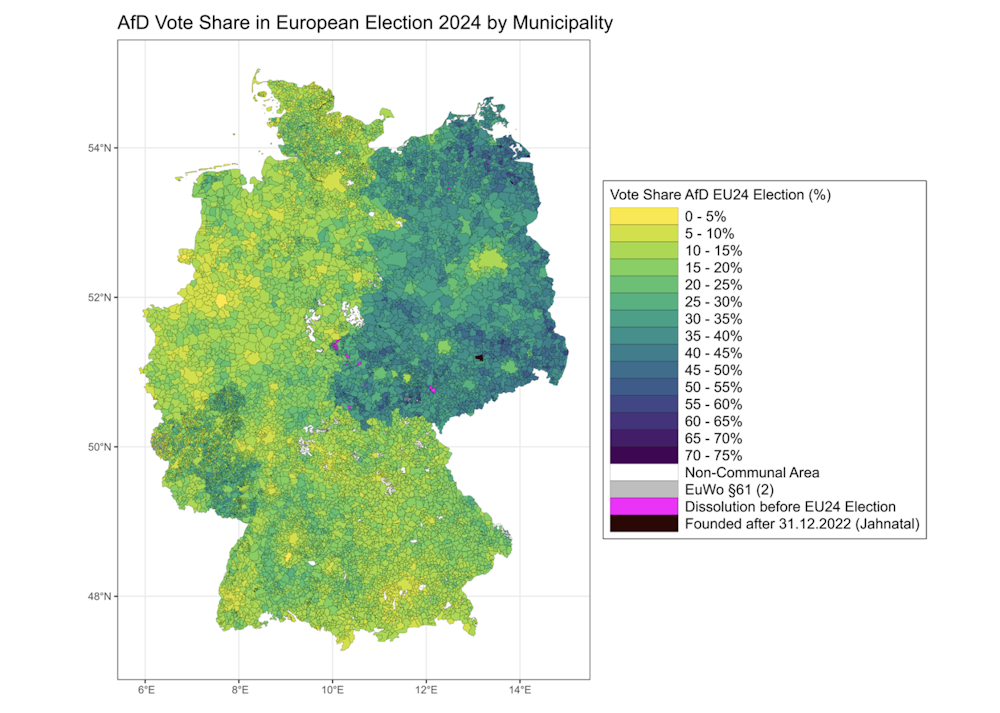
And ultimately, this politicisation translates into electoral outcomes. In the European parliament elections of June 2024, the AfD took 15.9% of German votes. If we look at the spatial distribution of the AfD’s vote, a pattern showing the salience of the urban-rural divide emerges.

East and west, town and country

It’s clear by looking at the map that most (though not all) of the AfD’s strongholds are in eastern Germany – the region which used to be the German Democratic Republic (GDR). Fascism and Nazism were outlawed by decree when this anti-fascist state was established but, in reality, far-right ideologies don’t die off that easily. The result was that extremist views survived in an environment where there was also a lack of education on the National Socialism of the past – and a lack of education about democracy.

When the socialist authoritarian GDR regime fell in 1989, Germany was reunified under western conditions. This had various effects, including a sense that the experiences of the east were not valued. The inequalities between the two sides of the reunified nation have left some in the east feeling distant from the state. The AfD’s version of nationalism finds fertile ground here.

Another pattern is also clear across the whole country: the AfD is stronger in remote and rural areas and weaker in urban centres. There is less support in cities such as Berlin, Cologne, Dresden, Hamburg, Leipzig, Munich and Stuttgart. Places with more globalised cultures, international business and diverse populations remain comparably resilient to the spread of the far right.

A map showing that support for the AfD is massively concentrated in the east of Germany and in other rural areas.
AfD support in different municipalities. The darker the colours, the higher the AfD vote share. R Frankenberger, CC BY-ND

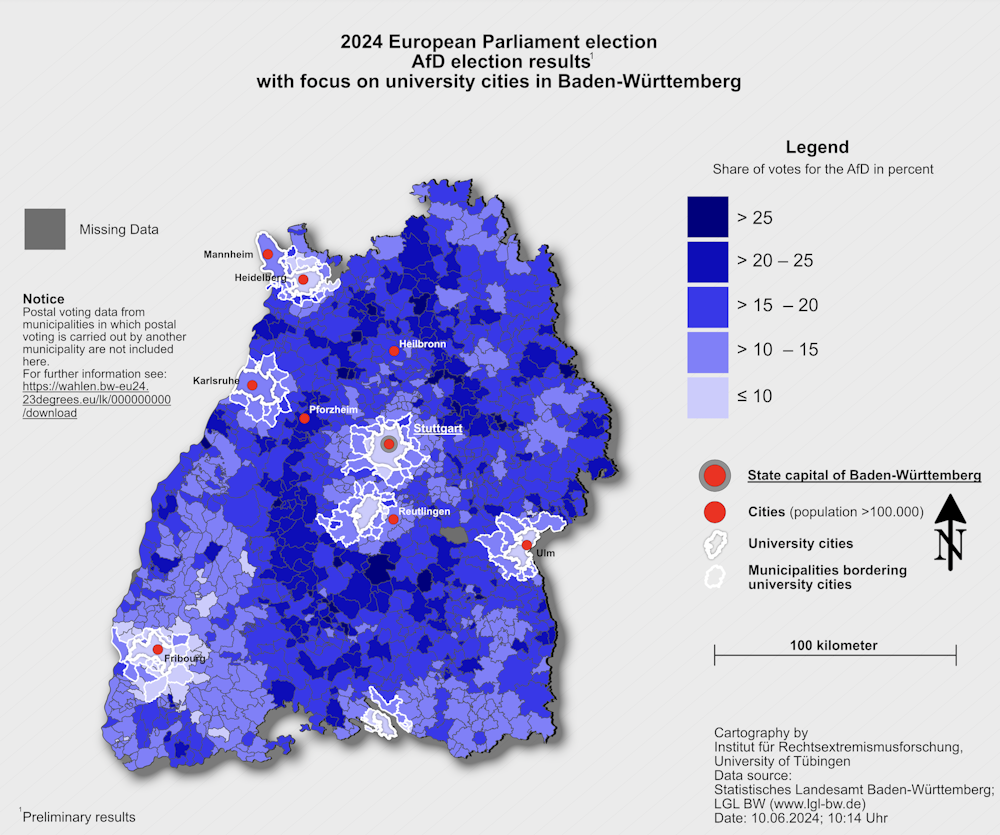
These patterns become more visible if you take the European election results in the state of Baden-Württemberg as an example.

The AfD performs significantly worse in the more globalised, cosmopolitan and university-oriented urban areas and their suburbs than in the more remote and rural areas of Baden-Württemberg. On the map, university cities are marked out with a white outline.

A map showing where support for the AfD is highest and lowest, with university cities highlighted to show how low support is in those areas.
AfD support mapped, with university cities highlighted. University of Tübingen, CC BY-ND

The AfD is particularly strong in the northern and eastern Black Forest, on the Baar, in the Swabian Alb, in the Rems-Murr district, in the Swabian Forest and in Hohenlohe. Most of these areas are remote, with many small towns and villages. They have slightly lower income levels and lower levels of migration than average. They are much more traditional in terms of culture and religion than urban areas.

The Black Forest, the Swabian Forest, and Hohenlohe also have quite strong protestant and evangelical communities, which are strongholds of traditional family life, customs and traditions.

We should expect to see these trends continue. The AfD looks set to make further gains in the February 23 election being held in Germany, retaining its strongholds in the east but also spreading into the west in rural areas. The urban-rural divide will therefore become all the more apparent and entrenched when German voters head to the polls.

Rolf Frankenberger, Managing Director Research, Institute for Research on Right-Wing Extremism (IRex), University of Tübingen

This article is republished from The Conversation under a Creative Commons license. Read the original article.

Where support for Germany’s far-right AFD is growing and why – podcast

Laura Hood, The Conversation

Germany is holding an election on February 23 and the contest is attracting an unusual amount of attention. That’s because the far-right Alternative for Germany (AFD) is polling in second place on 20% of the national vote.

Should the party end up with a vote share on this scale, it would be its best ever result in a national election. It would change the face of the German parliament and force mainstream parties into difficult questions about their longstanding refusal to work with extreme parties.

The AFD’s roots are in nationalistic and racist movements. It continues to take an ultra anti-immigration stance and, in this election, is calling for “demigration” – effectively the deportation of migrants.

In this episode of The Conversation Weekly podcast, Rolf Frankenberger, an expert on right-wing extremism at the University of Tübingen in Germany, explains where the AFD draws its support from and what type of Germany it wants to return to.

Frankenburger has found two clear trends in the geographical distribution of AfD voting. The first is common among far-right parties around the world:

“ There are always exceptions, of course, but the main pattern is that around the big cities like Berlin, like Hamburg, Bremen, Hanover, Münster, Stuttgart, Munich, Frankfurt in these cities and their direct environment and suburbs, the AFD is less important. Whereas in the specific rural areas, like in Saxonia, in the Erzgebirge, in Baden-Württemberg, in the Black Forest, in Rhineland Palatinate, in the more rural areas, they have their strongholds.”

The second, however, is unique to Germany. Support for the AFD is far more concentrated in the east of Germany. This region was the part of the country that made up the communist German Democratic Republic between 1949 and 1990, before German reunification.

“Reunification in Germany produced winners and losers. And in the view of many East German people – and much of it is true – there are inequalities that were produced by reunification.”

These divisions are being exploited to push what Frankenburger terms a form of white supremacist, traditionalist “Völkisch nationalism” – not a term that is well understood outside of Germany but which resonates heavily in domestic politics.

“And so the AFD comes in and says ‘hey, there’s something wrong with the state, there’s something wrong with democracy, and there’s something wrong with our heritage. So we have a strong German heritage. We have an identity, we have an idea and all the others are trying to destroy it’. So it’s a kind of protest.”

To find out more about narratives pushed by the AFD, listen to the interview with Rolf Frankenberger on The Conversation Weekly podcast.


This episode of The Conversation Weekly was written and produced by Mend Mariwany and Gemma Ware. Sound design was by Michelle Macklem, and theme music by Neeta Sarl.

Clips in this episode from AFP News, AfD in English, DW News and Al Jazeera English.

Listen to The Conversation Weekly via any of the apps listed above, download it directly via our RSS feed or find out how else to listen here.

Laura Hood, Host, Know Your Place podcast, The Conversation

This article is republished from The Conversation under a Creative Commons license. Read the original article.

Alltagsästhetik, Lebenswelt und (Rechts)Extremismus

Um zu verstehen, wie und warum rechtsextreme Narrative auch in nicht politische Diskurse und Alltagsbezüge eindringen können, bedarf es eines qualitativen und lebensweltlichen Zugriffs auf Rechtsextremismus. Dazu gehört insbesondere ein Verständnis davon, welche alltagsästhetischen und lebensweltlichen Muster, Symbole, Formen und Inhalte aus der „Mitte der Gesellschaft“ gezielt genutzt werden, um online und offline rechts extreme Ideologeme zu verbreiten – indem sie anschlussfähig an nicht genuin rechtsextreme Aus drucksformen gemacht werden. Beispielhaft dafür sind etwa die ästhetischen Inszenierungen rechter Influencer*innen auf Social Media Kanälen, die sich wahlweise konservativer, traditionaler und patriarchaler oder progressiver, emanzipatorischer Ästhetiken bedienen, um rechte Ideologeme zu transportieren.

Aufbauend auf bestehenden Untersuchungen und einer existierenden Typologie verschiedener sozialer und politischer Lebenswelten (Frankenberger et al. 2015; Frankenberger et al. 2019) schlagen wir in unserem neuesten Beitrag zum Tagungsband der Wissenschaftskonferenz 2023 des BfV eine qualitative Forschungsstrategie vor, bei der nicht nur rechtsextreme Lebenswelten, sondern auch und vor allem nicht extreme Lebenswelten untersucht werden, um analysieren zu können, welche Anschlussfähigkeiten und Mobilisierungs potenziale dort bestehen und gezielt genutzt werden, um rechtsextreme Ideologien und Wert haltungen, Prinzipien der Lebensgestaltung und Beziehungsmuster zu verbreiten.

Rolf Frankenberger and Daniel Buhr (2024): Alltagsästhetik, Lebenswelt und (Rechts)Extremismus. Für eine qualitative, alltagskulturelle Analyse extrem rechter Ideologien, Narrative und Akteure. In: Bundesamt für Verfassungsschutz (Hrsg.): Wissenschaftskonferenz 2023. Meinungsbildung 2.0 – Strategien im Ringen um Deutungshoheit im digitalen Zeitalter. Köln. Online: https://www.verfassungsschutz.de/SharedDocs/publikationen/DE/zaf/tagungsband-wissenschaftskonferenz-2023.pdf?__blob=publicationFile&v=3.

Researching far right extremism.

How should we do research on far right extremism? That was a main question we were aiming to answer during the process of making the Institute for Research on Far Right Extremism (IRex) work. As a steering group, we formulated our transdisciplinary, lifeworld, and political culture perspective in a research note published with ZfVP in November 2023.

Far right extremism, understood as both an ideology of inequality and exclusion that manifests itself in attitudes and behavior as well as a heterogeneous movement, partially with affinity to violence, challenges and even threatens democratic societies. We argue that social science research on far right extremism contributes to strengthen democracy and civil society against this threat. By adopting a transdisciplinary, lifeworld (Lebenswelt) and political culture perspective, social science can contribute to this task and also help to overcome the fragmentation of the research field. In this article, we first provide an overview of current developments in social science research on far right extremism with a focus on Germany. Second, we outline five premises for such a transdisciplinary research perspective on far right extremism. Thus, we argue for adopting both a theoretical perspective built around the lifeword’ concept and methodological pluralism. Third, we propose four interrelated thematic clusters as a taxonomy of transdisciplinary research perspectives on far right extremism: a) Far right ideologies and knowledge constructions; b) Far right actors, organizations, and networks; c) Far right extremist discourses, (digital) media, and strategies in the public sphere; and d) political education, transfer, and implementation research regarding projects against far right extremism. Fourth, we argue that further institutionalization research on far right extremism is indispensable to make research on far right extremism more sustainable, to connect research with societal actors, and to utilize research results to strengthen society’s democratic resilience.

Read more in the open access paper:

Frankenberger, R., Baur, R., Rieger-Ladich, M., Schmid, J., Stauber, B., Thiel, A., Thomas, T. Researching far right extremism—a transdisciplinary, lifeworld, and political culture perspective. Z Vgl Polit Wiss (2023). https://doi.org/10.1007/s12286-023-00580-w


Categories