Archive for the 'Uncategorized' Category


ECPR Joint Sessions in Münster

From 22. to 26. March, the ECPR Joint Sessions of Workshops will take place in Münster, Germany. There will be 28 workshops on different areas of political research. The one I will participate at will be on “Comparing Autocracies: Theoretical Issues and empirical Analyses of Inpput/Output Dimensions”. This workshop is chaired by Patrick Köllner (GIGA German Institute of Global and Area Studies and Steffen Kailitz (Hannah Arendt Institute for rersearch on Totalitarianism). It aims at bringing togehther scholars of Autocracies to debate on different issues, adressing theoretical, conceptual approaches as well as empirical analyses of authoritarian rule in general and input/output relations in special.

I will have the opportunity to present a rather theoretical paper named “killing two birds with one stone. Systems Theory and Autocracies re-considered”. What I am proposing with the paper is that the rather fragmented and unsystematic research on Autocracies could profit from using the rather old-school approach of social systems developed for example by Talcott Parsons, David Easton and Gabriel Almond. My argument is that a revised and modernized re-reading of Parsons can offer fruitful insights into the functions, structures and exchange processes, i.e. the input/output dimensions, of autocracies. It offers a way not only towards deeper understanding of autocracies but also of conceptualizing them beyond the pitfalls of greyzones, mixed types and democracy as a normative frame of reference that often have been discussed. As Systems differ in terms of functional equivalents and societal interchange, there is no need of a discrete analysis of democracy and autocracy, as the distinct combination of structures and functions offers a typology that is both comprehensive and mutually exclusive. This opens the way of a re-conceptualization of autocracy as a genuine type of social system (not only political system) that is defined by its unique structural composition as well as original interchange systems. This implies that there has to be a two level analysis of autocracies: first on the societal level with structural composition and interchange processes between political system, economic system, integrative system and cultural system , and second on the sub-societal level with the structural composition and interchange processes within the political system.

Within the paper I argue that whereas in democracies adaptation is organized by the economy and goal attainment by the political system, in autocracies this is the other way round with the political system fulfilling the adaptive function and the economy delivering goal attainment (Interestingly they do not seem to differ with regard to the integrative and pattern maintainance functions). Thus special interchange relations are established (i.e. neo-patrimonialism, corruption).

I am really forward to the workshop, not only because I want to get feedback for my paper, but also because there are really interesting scholars from all over Europe and beyond.
Authoritarianism reloaded

From 11-14 June a workshop on authoritarian political systems will bring together scholars at the Conference Centre “Haus auf der Alb” of the Landeszentrale für Politische Bildung Baden-Württemberg to discuss their approaches to autocracies, dictatorships, authoritarian political systems. There will be a broad range of topics presented and discussed from conceptional and theoretical approaches  to more empirical case studies and comparative studies. Although working language will be German, the programme could be of interest.

In a first round, conceptional and theoretical approaches will be presented. Steffen Kailitz will give an overview on the state of the art of autocracy-research in Germany and beyond. A profound and critical assessment of strategies of conceptualization, regime typologies and the problem of the continuum of democracy and totalitarianism will be presented by Kevin Koehler and Jana Warkotsch. As a third conceptual approach,  Holger Albrecht and Rolf Frankenberger advocate the necessity of an analysis of authoritarian regimes without democracy-sunglasses and present a conceptualization inspired by system theory of  Talcott Parsons.

A second point will be the question of systems, structures and institutions. Thomas Demmelhuber will present an analysis of the “Gamal-clique” in Egypt to illustrate new mechanisms of power and rule. Christina Trittel investigates the role and functions of parliaments in authoritarian regimes using the example of the National Assembly of Belarus from 1996 to 2009.

The relationship between State, Society and Economy will be the focus of the third discussion round. Daniel Lambach and Christian Goebel, organizators of the previously discussed workshop on authoritarian consolidation, are presenting their analytical framework on responsiveness of authoriatrian regimes. Subsequently, Gert Pickel examines whether or not authoritarian regimes are in need of (specific and diffuse) support as a core aspect of state-society-relations. picking up this perspective, Susanne Pickel and Toralf Stark explore and compare political cultures of authoritarian regimes on the basis of quantitative empirical data.

Change and reform will be at the core of the fourth session. Michael Schmidmayr discusses the directions and reasons of reform processes in the arab gulf states, Christian Timm is investigating the functional logics of post-transformatory regimes after transitions from neopartimonial rule, and Marco Buente will give an overview on authoritarian regimes in East Asia

In the last session, stability and reproduction of authoritarian rule will be in the focus of discussion. Petra Stykow will open the the las session on stability and reproduction of authoritarian rule with an anaylsis of mechanisms of reproduction of non-democratic regimes in the postsowjet space. Christoph Stefes and Jenniver Sehring choose a comparative perspective on stability of competitive authoritarian regimes in Armenia, Georgia, Kazakhstan and Kyrgyzstan. Last not Least, Beatrice Schlee will investigate mechanisms of survival in times of crisis in Zimbabwe.

A discussion of perspectives of research on authoritarianism will close the workshop on late saturday. A brief summary of papers and main results of discussions will be published here betimes.

It seems that strange things happen…

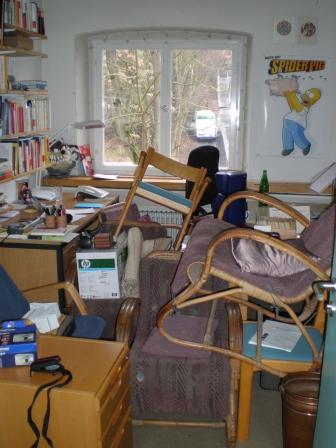
… when you decide to leave your office for holydays. Or at least this is what happened when I was off duty for a week skiing with my family in the lovely Bayerischer Wald in south-east Bavaria. I am sure that I had cleaned my office up before I left  it ten days ago, and I am not aware of having said anything to anyone like: ” Hey, it’s ok, I do not use it anymore, just put all your junk in it!”. But nevertheless, unlocking my office and opening the door, this was what I saw today at 8.45:

office2

If that is the way the organization is concerned with its reliable, hard working employees, I don’t want to know what they do with the inferior ones (might they resurrect the Spanish Inquisition?). For Gods grace they didn’t touch my spiderpig-poster!

So, if you do not want to find your office in such condition, never go on vacation!

KopfmaennchenConsult

Sometimes it is necessary to re-arrange things. This led Clemens and me to open a new blog for professional purposes: KopfmaennchenConsult. This is the place where you find information about what we can offer to you. In turn, Kopfmaennchen now is – as it was some time – my privat-public space, where I will blog what I am interested in.

Willkommen!

Hallo SurferIn,

es freut mich, dass Du hierher gefunden hast. Wäre ja möglich, etwas Interessantes zu finden. Jean Baudrillard hat im Jahr 1978 argumentiert, die Massenmedien seien in erster Linie anti-mediatorisch und intransitiv, da sie Nicht-Kommunikation fabrizierten. Die Medienarchitektur scheint sich zu ändern, es sei denn Bloggen ist Simulation und Blogs sind Simulakra postmoderner Kommunikation. Spaß macht es trotzdem.


Categories