Archive for the 'Uncategorized' Category


Policy Making and Legitimation in Autocracies

In addition to repression and co-optation, authoritarian regimes use redistributive and legitimizing strategies in order to secure their survival. In a new article my collegues Aron Buzogány, Patricia Graf and I conceptualize and discuss different opportunities of legitimation through policy-making that can be used in autocracies. We exemplify this concept by outlining and comparing autocratic legitimation strategies in innovation policy. Legitimation through policy-making is a double-edged sword, as it includes both potentials and risks for legitimation.

  • Aron Buzogány, Rolf Frankenberger & Patricia Graf (2016): Policy-Making und Legitimation in Autokratien: Das Beispiel der Innovationspolitik. Totalitarismus und Demokratie 13 (2), S. 257–280.

Tübingen and Petrozavodsk- strengthening linkages

The twin cities Petrozavodsk (Karelia, Russian Federation)  and Tübingen (Baden-Wuerttemberg, Germany) recently celebrated 25 years of their partnership. There are close relations between the municipal governments, civil societies and citizens, who are engaged in strengthening this vital exchange.

imag0743

The sculpture “Fishermen”, placed at the Shore of Lake Onega,might symbolize many things, but indeed stands for the power of people working together in order to achieve their goals. In this way, it might also stand for the puropse of a project we set up in October, when we added a new dimension to the partnership between Tübingen and Petrozavodsk.In a joint workshop with social scientists, civil society representatives and representatives of the two municipalities of both cities discussed their perspectives on Participation, Civil society and local politics. This workshop was funded by the German Academic Exchange Service and took place in Petrozavodsk from 25 to 29 October 2016.

The workshop brought together more than thirty researchers and practitioners in the area of citizen participation, NGOs and state-society-realtions. It aimed at deepening the ties between actors from both cities as well as at exchanging knowledge and discussing future joint projects. In four sessions, the participants discussed topics as:

  • Social Innovation, Participation and the Quality of Life
  • Participation in the implementation of municipal policies
  • Power, State, and Society – research in and insights from sociology and political science
  • Participation in the humanitarian sphere: Experiences of inter-municipal cooperation.
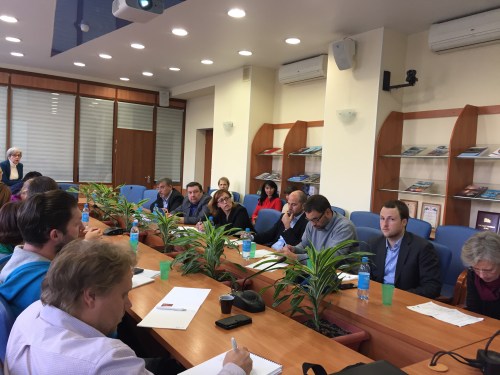
img_4425

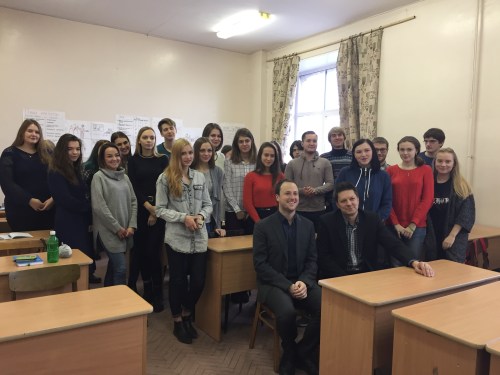
Also, the pariticipants from Tuebingen held open lectures at the Petrozavodsk State University on topics of their work, e.g. on the chances of municipal cooperation, local participation, social innovation and political culture.
img_4340

One other main part of the workshop was dedicated on projects in civil society aiming at inclusion and participation of citizens. These are the sites where social innovation takes place and where solutions for many problems of everyday life are adressed by citizens, volunteers, professionals and scientists. Therefore we visited social institutions and exchanged experiences with practitioners in the area of healthcare and social work.

The workshop ended in a roundtable discussion where future steps of participation were not only discussed, but fixed. A first step will be a publication presenting the results of the workshop that will be published with Nomos-Publishers. In a second step we will develop a joint research plan and apply for funding for a joint cross-regional and inter-municipal comparative project in the fields of social innovation and participation.

Municipalities in a comparative perspective.

In a new publication I discuss theoretical and methodological issues of comparing Municipalities in Germany and Russia (or more in genereal, if you want, in any cross-regional comparison of cases). Drawing on experiences in cross-regional comparisons of Russia and Venezuela (Frankenberger & Graf 2011; Frankenberger & Graf 2013) as well as Russian and German Municipalities (Frankenberger & Kiener 2015), I argue that it is a too narrow analysis, if you only focus on local political order. It might be more useful to widen the perspective in two ways. First, the systemic context has to be taken into account. This is not only true for formal multilevel governance but also for informal institutions and politics.

Informal Politics and relations between actors on the municipal level are often mor important than formal power relations and party affiliations. Especpecially when it comes  to conrete projects. One solution to the problem in comparing municipalities from different regions could then be to use structuralist and functionalist approaches as heuristics: What institution and what actor doe fulfil which functions in the respective context? How do they interfere/interact with political culture, political economy and the broader political system? Even if this heuristics might not lead to a rigorous case design as MDSD or MSSD, the insights of the comparison are far more systematic and generalizeable than they would be by doing single case studies

  • Rolf Frankenberger (2016): Ungleiches im Gleichen. Theoretische und methodische  Herausforderungen des Vergleichs von Kommunen in Deutschland und Russland. Jahrbuch des Föderalismus. Baden-Baden: Nomos, S.137-150.

Wettbewerbsorientierung und Strategiefähigkeit – die Zukunft der Wissenschaft?

Welche Chancen bieten Wettbewerbsorientierung und Strategien für die Zukunft des Wisenschaftssystems? Dieser Leitfrage und den damit verbundenen Teilaspekten gehen Verantwortliche und ExperInnen aus Wissenschaft und Politik im Rahmen einer Wissenschaftskonferenz des Netzwerk Exzellenz an deutschen Hochschulen der Friedrich Ebert Stiftung am 19. und 20. September in Berlin. Ziel ist die Identiikation von neuen Impulsen für die strategische Debatte in der Wissenschaft.

imag0717

Den Auftakt am Dienstag machten Edelgard Bulmahn, MdB und Hubert Heil, MdB mit einer Reflektion auf Stärken und Schwächen des Wissenschaftssystems. Danach gab Brian S. Mitchell, Professor an der Tulane University und Dean-in-Residence, Council of Graduate Schools / National Science Foundation, USA einen Impuls zu Wettbewerbsorientierung, Differenzierung und Profilbildung

In einer zweiten Runde gab Prof Dong Qi, ehemaliger Vize-Präsident der Tongji Universität Schanghai und Gesandter Botschaftsrat der VR China einen Einblick in die strategische Entwicklung des chinesischen Hochschulsystems. Die Frage der Strategiefähigkeit diskutierte er im Anschluss mit Prof. Dr. Peter-André Alt, Präsident Freie Universität Berlin, Steffen Krach, Staatssekretär für Wissenschaft der Senatsverwaltung für Bildung, Jugend und Wissenschaft Berlin und mir.

Über Anreiz- und Finanzierungssysteme für Lehre diskuierten Walter Jansen, Maastricht University, Prof. Dr. Julia von Blumenthal, Dekanin, Kultur-, Sozial- und Bildungswissenschaftliche Fakultät, Humboldt-Universität zu Berlin und Dr. Sabine Behrenbeck, Leiterin Abt. Tertiäre Bildung, Leiterin Bereich Exzellenzinitiative, Wissenschaftsrat mit Prof. Jürgen Zöllner, Vorstand Stiftung Charité, Senator a.D.

Forschendes Lernen

Forschendes Lernen erfreut sich in der Hochschullehre zunehmender Beliebtheit. Es zeichnet sich dabei ähnlich wie aktives und situiertes Lernen durch eine Vernetzung von Wissen und Projekt- und Problemorientierung aus. Der Schwerpunkt liegt dabei auf der Wissenschaftlichkeit des Vorgehens und es wird daher auch dezidiert Bezug auf wissenschaftliche Theorien und Methoden genommen. So definiert Euler (2005) Forschendes Lernen als das „aktive Erproben realer Handlungsabläufe unter Bezugnahmen auf persönliche Erfahrung und wissenschaftliche Theorien“. Das Durchlaufen eines vollständigen Forschungsprozesses konfrontiert Studierende unmittelbar mit der wissenschaftlichen Praxis und bietet so unschätzbare Lernerfahrungen.

Welche Grundlagen, Chancen und Herausforderungen mit forschendem Lernen verbunden sind, war Gegenstand eines von Daniel Lambach an der Universität Duisburg-Essen organisierten Workshops der Themengruppe Hochschullehre der DVPW am 15.September

Aus der Erfahrung mit mittlerweile zehn zweisemestrigen Lehrforschungsprojekten, die ich in den letzten Jahren an der Universität Tübingen (an)geleitet habe, zeigt sich jedoch auch, dass Forschendes Lernen in der praktischen Umsetzung eine Reihe von Herausforderungen an alle Beteiligten stellt, denen man sich als Lehrende und Lernende stellen muss. Diese Herausforderungen habe ich bei diesem Workshop vorgestellt und exemplarisch einige Lösungsansätze skizziert. Die Präsentation findet sich hier.

Informationen zum Workshop und zu Aktivitäten der Themengruppe finden sich auf dem Blog der Themengruppe Hochschullehre.

Literatur

  • Euler, D. (2005): Forschendes Lernen. In: Spoun, S.; Wunderlich, W. (Hrsg.): Studienziel Persönlichkeit. Beiträge zum Bildungsauftrag der Universität heute. Frankfurt am Main: Campus, S. 253–272
  • Kolb, D. (1984): experimental Learning. Experience as the Source of Learning and Development. Englewood Cliffs: Prentice-Hall
  • Westle, B. (2009) (Hrsg.): Methoden der Politikwissenschaft. Baden-Baden: Nomos
  • Wildt, J. (2009): Forschendes Lernen: Lernen im Format der Forschung. Journal Hochschuldidaktik, Jg. 20 (2009) Heft 2, S.4-8

Categories