Archive for the 'Power, Governance, Governmentality' Category


Authoritarianism reloaded

From 11-14 June a workshop on authoritarian political systems will bring together scholars at the Conference Centre “Haus auf der Alb” of the Landeszentrale für Politische Bildung Baden-Württemberg to discuss their approaches to autocracies, dictatorships, authoritarian political systems. There will be a broad range of topics presented and discussed from conceptional and theoretical approaches  to more empirical case studies and comparative studies. Although working language will be German, the programme could be of interest.

In a first round, conceptional and theoretical approaches will be presented. Steffen Kailitz will give an overview on the state of the art of autocracy-research in Germany and beyond. A profound and critical assessment of strategies of conceptualization, regime typologies and the problem of the continuum of democracy and totalitarianism will be presented by Kevin Koehler and Jana Warkotsch. As a third conceptual approach,  Holger Albrecht and Rolf Frankenberger advocate the necessity of an analysis of authoritarian regimes without democracy-sunglasses and present a conceptualization inspired by system theory of  Talcott Parsons.

A second point will be the question of systems, structures and institutions. Thomas Demmelhuber will present an analysis of the “Gamal-clique” in Egypt to illustrate new mechanisms of power and rule. Christina Trittel investigates the role and functions of parliaments in authoritarian regimes using the example of the National Assembly of Belarus from 1996 to 2009.

The relationship between State, Society and Economy will be the focus of the third discussion round. Daniel Lambach and Christian Goebel, organizators of the previously discussed workshop on authoritarian consolidation, are presenting their analytical framework on responsiveness of authoriatrian regimes. Subsequently, Gert Pickel examines whether or not authoritarian regimes are in need of (specific and diffuse) support as a core aspect of state-society-relations. picking up this perspective, Susanne Pickel and Toralf Stark explore and compare political cultures of authoritarian regimes on the basis of quantitative empirical data.

Change and reform will be at the core of the fourth session. Michael Schmidmayr discusses the directions and reasons of reform processes in the arab gulf states, Christian Timm is investigating the functional logics of post-transformatory regimes after transitions from neopartimonial rule, and Marco Buente will give an overview on authoritarian regimes in East Asia

In the last session, stability and reproduction of authoritarian rule will be in the focus of discussion. Petra Stykow will open the the las session on stability and reproduction of authoritarian rule with an anaylsis of mechanisms of reproduction of non-democratic regimes in the postsowjet space. Christoph Stefes and Jenniver Sehring choose a comparative perspective on stability of competitive authoritarian regimes in Armenia, Georgia, Kazakhstan and Kyrgyzstan. Last not Least, Beatrice Schlee will investigate mechanisms of survival in times of crisis in Zimbabwe.

A discussion of perspectives of research on authoritarianism will close the workshop on late saturday. A brief summary of papers and main results of discussions will be published here betimes.

Towards an Analytics of Information Society

When we are talking about Information Society or, as Manuel Castells puts it the Information Age, we are apt to pronounce the positive sides, advantages, and acquirements of this global development. That information and knowledge are central objects and means of power exertion, governance and domination often is neglected or at least not explicitly articulated in public discourses. But from various thinkers, e.g. Michel Foucault, we know that power and knowledge can form complexes, information can become knowledge that is used for domination. The distinction between codifiable and non-codifiable knowledge can constitute forms of domination and the access to information can cause new forms of social stratification and marginalization. The so called digital divide separating the older, less educated and more traditional parts of society from the more progressive, higher educated and younger rest is just one example. To develop an Analytics of these power relations that constitute the information society in various ways, a re-lecture of Jean-Francois Lyotard, Michel Foucault and jean Baudrillard together with newer approaches as Manuel Castells’ seminal work can be helpful.

The particular importance of information and knowledge for postmodern societies has been analyzed in different ways. In “The Postmodern Condition: A report on knowledge”, Jean Francois Lyotard argues that information processable in binary code receives special appreciation in the age of digitalization. This affects all information that can be represented by sequences of Zeros and Ones (00101000111). In other words: only this kind of information can be processed and analyzed by computers, what is of main importance in times of enormous data flow rates. As this encoding is not possible for all kinds of information, some forms of information and knowledge – and with them the bearer or carrier – are discriminated against. This process of selection and hegemonialization of digitally processable information and knowledge tends to banalize information beyond this boundary. They are excepted from the digital discourse.

New parallel information societies with their own specific rules and codes emerge through these mechanisms of selection. We can argue with Michel Foucault that new “orders of the discourse” emerge, that compete for access to power and domination, and to politics.

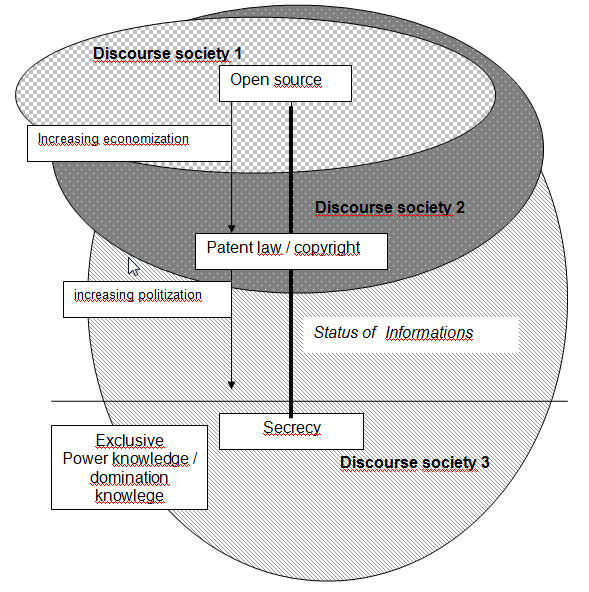
Discourses are amongst other things characterized by the access to information with different status: open source, being subject to patent law or copyright, declared as top secret. The latter can be called exclusive domination-knowledge. In this context, a capitalism of information emerges and a new meta-narrative takes form around the paradox myth of information stating that strength and innovation arise from information and knowledge. As a consequence information should be particularly protected and at the same time access should be kept as free as possible. The latter often refers to information that are neither relevant for business nor for security. Within an economy of information, no one profiting economically from informationn can be interested in a total freedom of information. On the other hand, new subcultures and information producers form up around banalized and seemingly irrelevant and therefor open source and freely accessible information and knowledge (This means the emergence of a new economy of information, indeed). New constellations of emitter/dispatcher, media, and receiver/recipient with totally new logics can be observed, as for example Web 2.0 shows. That these developments abet Baudrillard’s thesis of the denouement of realities is another chapter of another story.

Another important point seems to be the exponentially growing production rate of information. This point evokes different interpretations: First, that reality itself disappears with the flood of informations and the dissolution of the difference between emitter and recipient, message and medium. Reality is transformed into simulations, as Jean Baudrillard would have put it. He describes this information society as follows: „Such is the last stage of the social relation, ours, which is no longer one of persuasion (…) but one of deterrence: `YOU are information, you are the social, you are the event, you are involved, you have the word etc`.“. Und weiter: „No more subject, no more focal point, no more center or periphery: pure flexion or circular inflexion“ (Baudrillard 1994:29). Second, there is an idea of global control and “empowerment, on the basis of globally available masses of information. This discussion encompasses the work of Michel Foucault in “discipline and punish” and Jeremy Bentham’s “Panopticon” as well as the newer work on Security and Risk, and the Surveillance Studies.

It seems to be necessary to develop the dimensions of an Analytics of Information Society according to these roughly specified approaches. Within the framework of a political economy of Information, these dimensions are relevant for a study of power relations and domination within information society on the levels of society, of information and on a processual level. On the societal level this would include 1) social control vs. social dissolution; 2 simulation vs. reality of identity; 3) integration vs. exclusion in discourse societies. On the processual level this would mean to analyze communication in terms of 4) emitter vs. recipient, and 5) liberty vs. limitation. Last but not least this would include the dimensions 6) binary codes vs. narratives; 7) relevance vs. irrelevance; 8 ) economic vs. non-economic usability and 9) security contents on the informational level.

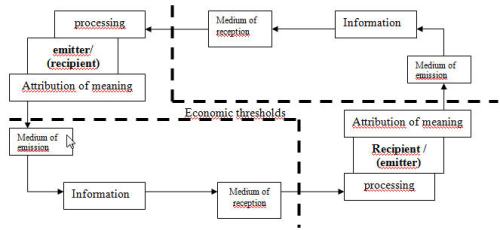
Starting from these dimensions, various models of an analytics of information society emerge. They can be used on different levels or can link the dimensions with each others. For example, economic thresholds can prevent emitters from emitting and recipients from receiving (costs for internet or licenses, copyright etc.). Though, there has to be made an economic decision, whether and if, which, resources are used for one or another information and which results are expected. This is especially relevant for political decision making, governance and leadership.

Chart 1: the economization of informational exchange
economization1

Over the categorization of various informations and the simultaneous economization and politization a double hierarchization of knowledge and information emerges: economically, i.e. patent law and copyright and the trading of information and licenses, that are by far not affordable for all; politically through the classification of knowledge as relevant for security, top secret etc. This hierarchization of information then causes a hierarchization of discourses and discourse societies as information is availabe to different degrees (how can I argue against the use of nuclear weapons or energy without results of clinical studies showing the impacts of radiation?). At the same time this can mean that power discourses are cut off from relevant information as information from subcultures or alternative ways of communication cannot be processed.

Chart 2: Figuration of Discourse societies

discourse<!–[if !mso]> <! st1\:*{behavior:url(#ieooui) } –>

Related Reading:

  • Baudrillard J (1983) Simulations. New York: Semiotext(e).
  • Baudrillard J (1994) Simulacra and Simulation. Translated by Sheila Faria Glaser. Ann Arbor: University of Michigan Press
  • Baudrillard, Jean; Glaser, Sheila Faria (2006): Simulacra and simulation. 15. Druck. Ann Arbor: University of Michigan Press.
  • Bell, Daniel 1973: The coming of post-industrial society. A venture in social forecasting”, New York, NY
  • Burchell, Graham; Foucault, Michel (2007): The Foucault effect. Studies in governmentality ; with two lectures by and an interview with Michel Foucault. [Nachdr.]. Chicago, Ill.: Univ. of Chicago Press.
  • Castells, Manuel (2006): End of millenium. 2. ed., [New. ed., Nachdr.]. Malden, Mass.: Blackwell (The information age, Vol. 3).
  • Castells, Manuel (2006): The power of identity. 2. ed., new ed. reprint. Cambridge, Mass.: Blackwell (The information age, Vol. 2).
  • Castells, Manuel (2008): The rise of the network society. 2. ed., new ed., [Nachdr.]. Malden, MA: Blackwell (The information age, Vol. 1).
  • de la Mothe, John/Paquet, Gilles 1999: Informational Innovation and their impacts, in: (ibid): Information, Innovation and Impacts, Chapter 1, Boston.
  • Dean, Mitchell (2007): Governmentality. Power and rule in modern society. Reprint. London: Sage Publ.
  • Foucalult, M. (2001): The Order of things: an Archeology of Human Sciences. London:Routledge
  • Foucault, Michel (1991): Governmentality. In: Burchell, Graham; Foucault, Michel (Hg.): The Foucault effect. Studies in governmentality ; with two lectures by and an interview with Michel Foucault. Chicago, Ill.: Univ. of Chicago Press, S. 87–104.
  • Foucault, Michel (1995): Discipline and punish. The birth of the prison. 2nd Vintage Books ed. New York: Vintage Books.
  • Foucault, Michel (2002 /// 2007): The order of things. An archaeology of the human sciences. Repr. London: Routledge (Routledge classics).
  • Foucault, Michel; Gordon, Colin (1980): Power/knowledge. Selected interviews and other writings, 1972 – 1977. New York: Pantheon Books.
  • Lash, S. / Urry, J. (1993): Economies of signs and space. London:Sage
  • Lyotard, Jean-Francois (1989): The postmodern condition. A report on knowledge. 7.print. Minneapolis: University of Minnesota Press (Theory and history of literature, 10)
Best day ever – Cheru Jackson and alphainventions.com

Surprise, surprise: Best day ever regarding clicks on my blog. Why? Because I wrote such an interesting article? Dream on! Doing a little second of research in my blog-statistics showed the referrer alphainventions.com as main source of users. What the hell of an adress is that, I asked myself, and discovered Cheru Jackson and his project of “supervising” blogs that are actually updated. When I understood it right, alphainventions is a kind of scanner searching for blogs updated at the respectively actual moment people are visiting it. According to Jackson it is the main aim to bring together boggers in realtime to foster communication and exchange. Really interesting and striking, as it has risen traffic from an average of 8 a day to currently 61 (17:59, GMT +1)  for today, with tendency rising.

To overlook news in the blogsphere thus seems to become more easy and comfortable. Fine. Let’s see where this development will lead to.

As I am a political scientist, I actually see some other facets of this project that are by far not deliberative. As authoritarian political systems are in need for knowing what is going on in their interior in order to preserve themselves from being surprised by the uprising of opposition forces, they always look for new technologies to control and monitor all subversive activity. As we know from some authoritarian regimes, e.g. Iran and China, there is a vital blog-culture in which underground and opposition forces are active and inform us of developments in these rather closed systems. Thus alphainventions could be used in different ways: On the one hand, it can make such blogs (amongst others) more popular and powerful, but on the other hand, this tool can be used for repression as well. From a surveillance studies point of view I would strongly suggest Cheru to keep the codes of alphainventions topsecret. What a powerful tool to monitor such activities. Combined with IP-trackers: perfect tool.

But enough of being the “Bedenkentraeger”, which is an excellent german word for seeing all from its’ negative side: Another positive aspect seems to be that the blogsphere becomes more lively in a sense that with alphainventions more instant “contacts” between bloggers are possible. The world again comes closer together, or in Sloterdijks terms, globality is once more enforced and brought closer to the people. I like this approach, even though I am sceptical about the quality of communication in a world of simulations and simulakra.

Language, Meaning, and Mental Representation

When I started working after my trip to Paris yesterday, I made a very intriguing experience. Listening to a dialogue between two people at the institute, it took me at least three minutes to identify that these people were talking German and that I should have understood them from the first second I listened. The same thing happened to me again later on that day. To test if there are other “handicaps”, I chose to solve a sudoku, as mathematical challenges shouldn’t be too closely related to semantic and grammatical ones. I am really addicted to Sudoku and usually can solve them quite quick, but this day I wasn’t able to solve at least an easier one.

As I am not professional psychologist I could have wondered if I was going crazy. No, not really, I suppose, but this led me to some reflections on language, mental representation and meaning.  To me it seems obvious that this incident is related with the fact that I was talking mostly English and French the last week and therefore was tuned in in a really different cognitive framework or script on how to associate meaning with the sounds and words I was hearing, as both are not my mother tongues. Not a really new insight, this can mean that the mental representation of meaning is a) closely connected to language; b) seems to be influenced by different organizational structures of different languages; c ) is interdependent with logico-mathematic thinking.

Linking these rather private experiences ant their implications with theories of social constructivism/ constructionism (e.g. Berger/Luckmann for sociology or Kenneth Gergen for sociopsychology), this underlines the relativity and fuzziness of social experience and research.If I cannot rely on my own perception and attribution of meaning top social phenomena over and across different situations and/or languages, how can I capture reality adequately? If mathematical thinking is closely linked with language systems, how can I produce reliable results from quantitave research and interpret the adequately?

Another problem is the limitation of topics and actors within not only scientific discourses.  As for example Michel Foucault shows, the order of the discourse usually  is strict and harsh in separating legitimate contributions and invisibilizing and delegitimizing non-valid ones. In connection with the order of the respective discourse, the highly encultured and subjective forms of perception (cognition and processing) and expression (arts and languages) construct social constraints of and within language, meaning and mental representation.  These “power/knowledge-blocks” (Foucault) become one foundation to invent and optimize culturally, historically, economically and politically embossed techniques of signification, domination and the self.

31st ISPP Annual Meeting in Paris

On Wednesday 9th July 2008, the 31st Annual Meeting of the International Society for Political Psychology will open its doors at Sciences Po, Paris. I am really looking forward to this conference, not only because Paris is one of the most beautiful cities in Old Europe, but also because there will be some very interesting panels. To learn more about the conference program, pleas visit the conference homepage. You can also search all papers presented of the conference there. I will present two papers. One ison an empirical research project about postmodernity and personality conducted in Germany. The other is a bit like selling coals to Newcastle, as it is named “Learning from Baudrillard and Foucault. Consumer Culture, Social Milieus and The Governmentality of Lifestyle” and is presented in Paris.I am looking forward to inspiring discussions.

This also means that I will be out of office most of the next week – sorry.


Categories