I had the opportunity to talk with Prof. Busygina, an expert on federalism and the economies of space at the MGIMO yesterday. We discussed the question of elections in Russia very briefly, but verz fruitful. There are four major points, that can be considered the results of this meeting. First, it is easy to run elections when there is no real opposition and therefore the chance of a defeat of the party of power is very little. Second, she told me about serious rumours that United Russia probably will experience a schism. This, in my opinion, might partly happen because the experiment of Just Russia did not work. Third, Prof. Busygina pointed out that the most important development of the last years was that there are less elections that ever since the elections of the governors were abolished. And last, not least, I asked her what she thinks the functions of parties and elections in Russia are. The answer was a little more complex, but I will briefly summarize it: People are really habitualized to elections as even the Soviet System held elections. The difference today is that they have a choice, and that there is an opposition, even if it is compliant with the system. I argued that elections probably are the only possibility for the elites to stay in touch with the electorate and probably have the function of a political seismograph and, after thinking about it, she agreed. Even though there are a lot of opinion polls, there is little credible information passing from the bottom to the top because of the huge problem of social desirability researchers have to deal with in Russia. Apparently, she said, people first look at you to estimate what the interviewers expectations are, and then they adjust their answer. But as they are habitualized to elections and now have the possibility to choose where to make their cross, the percentage of the party of power and of the other parties serves as a good indicator for the satisfaction of the electorate with the (national or local) government, at least in the urban regions. This is a very interesting argument. It will be interesting to do further research and fieldstudies on this pattern of what i call “electoral seismography”.
Archive Page 21
I had a quite strange close encounter with the third kind at the Prague Airport yesterday. Some meters ahead in the queue there was a platine-blonde, late-mid-aged, red-dressed russian lady trying to persuade the customs officer, that it would be allright to take the handgun on board that she was carrying with her. She was really, really upset, arguing all the time until she was on board, and probably still railing against these stupid regulations the customs officer wanted to implement, and indeed, finally did implement. Im looking for some more of theses encounters!!!!!
After having come back from my holiday at Rügen (or:Rugia – for those not familiar with german geography, Rugia is the largest german island, located in the Baltic Sea off the coast of Mecklenburg-Vorpommern), regular work will start on the next monday. And there is really a lot of work to do in the upcoming semester.
My current research focuses on theories of transition of political systems and particularly the transition to and stabilization of authoritarian regimes. The case of my interest is Russia, as it can be considered as an example for sucessful re-authoritarization under former President Vladimir Putin and current President Dmitrij Medwedew. One really interesting thing is that in Russia elections to the executive (the President) and the legislative (State Duma) are held regularly and seem to be of some importance and impact despite all rumours and proofs of manipulation. There are several scholars dealing with the phenomenon of elections in authoritarian regimes, that call these types “competitive authoritarian regimes” (Levitsky and Way 2002) or, more precise, “electoral authoritarianism” (Schedler 2006). These approaches seem to be helpful to distinguish these variations of a full-scale “authoritarianism+” from diminished subtypes of democracy, e.g. democracies with adjectives (Collier and Levitsky 1997) and hybrid regimes (Diamond 2002). But when one asks for the functions in terms of a system analysis, most of the approaches in transitology do not give satisfactory answers. My aim is to come closer to a non-democracy-biased analysis of functions of structures and actors within an autopoietic political system. I hope to get new inspiring insights when I am hopefully travelling to Moskow at the end of the month.
Developments in Russia are also interesting in a comparative perspective. Together with my collegue Patricia Graf, I am working on a compartive analysis of elections and their functions in Russia and Venezuela. We will present the results at the annual meeting of the “AK Demokratieforschung” of the DVPW in Hamburg from 16th to 18th October 2008.
Another project origins in my participation at the ISPP-Conference earlier this year. Together with Michael Arfken I am working on a contribution to the 2009 meeting. As we both are in some way (Michael as a psychologist) or the other (me as a political scientist) concerned with how social reality is represented in political psychology, we like the idea to debate different approaches to the social in political psychology, as thinkers like Marx, Hegel, Foucault, Baudrillard, Rawls and others developed them. We are planning to contribute a workshop or panel or symposium to the meeting that could be called “Political Psychology, Social Reality, and the Specter of Intersubjectivity”. Anyway, we have to wait for the reaction of the chairs of the conference.
In teaching there will be three courses, that I will give in the Wintersemester: “Introduction to Political Science” for B.A.-Students (1st Semester), the “Teaching-/Reasearch-Project” for B.A.-Students (5th and 6th Semester) and “Methods of Empirical Research in Political Science” for graduate students (Magister and Master). This includes the update and reformulation of all syllabuses and suggested readings.
Literature:
- Schedler, Andreas (Hg.) (2006): Electoral Authoritarianism. The Dynamics of unfree Competition. Boulder, Coll.: Lynne Rienner Publishers.
- Levitsky, Steven; Way, Lucan A. (2002): The Rise of Competitive Authoritarianism. In: Journal of Democracy, Jg. 13, H. 2, S. 51–65.
- Diamond, Larry (2002): Thinking about Hybrid regimes. In: Journal of Democracy, Jg. 13, H. 2, S. 21–35.
- Collier, David; Levitsky, Steven (1997): Democracy with Adjectives. Conceptual Innovation in Comparative Research. In: World Politics, Jg. 49, H. 3, S. 430–451.
There are many rumors about who Barack Husein Obama really is and what he stands for. Some say he is a muslim, some say he is not the right choice, and so on. But do you know the true story of Barack Obama a.k.a Banel Nicolita that even wikipedia and Jon Stuart do not know?
In real life the democrats’ presidential candidate 2008 is a romanian football professional just having been part of Romanias Team at the UEFA EURO 2008, that hopefully will not be a benchmark for Baracks success in the elections.
Doubts?
Look at this:
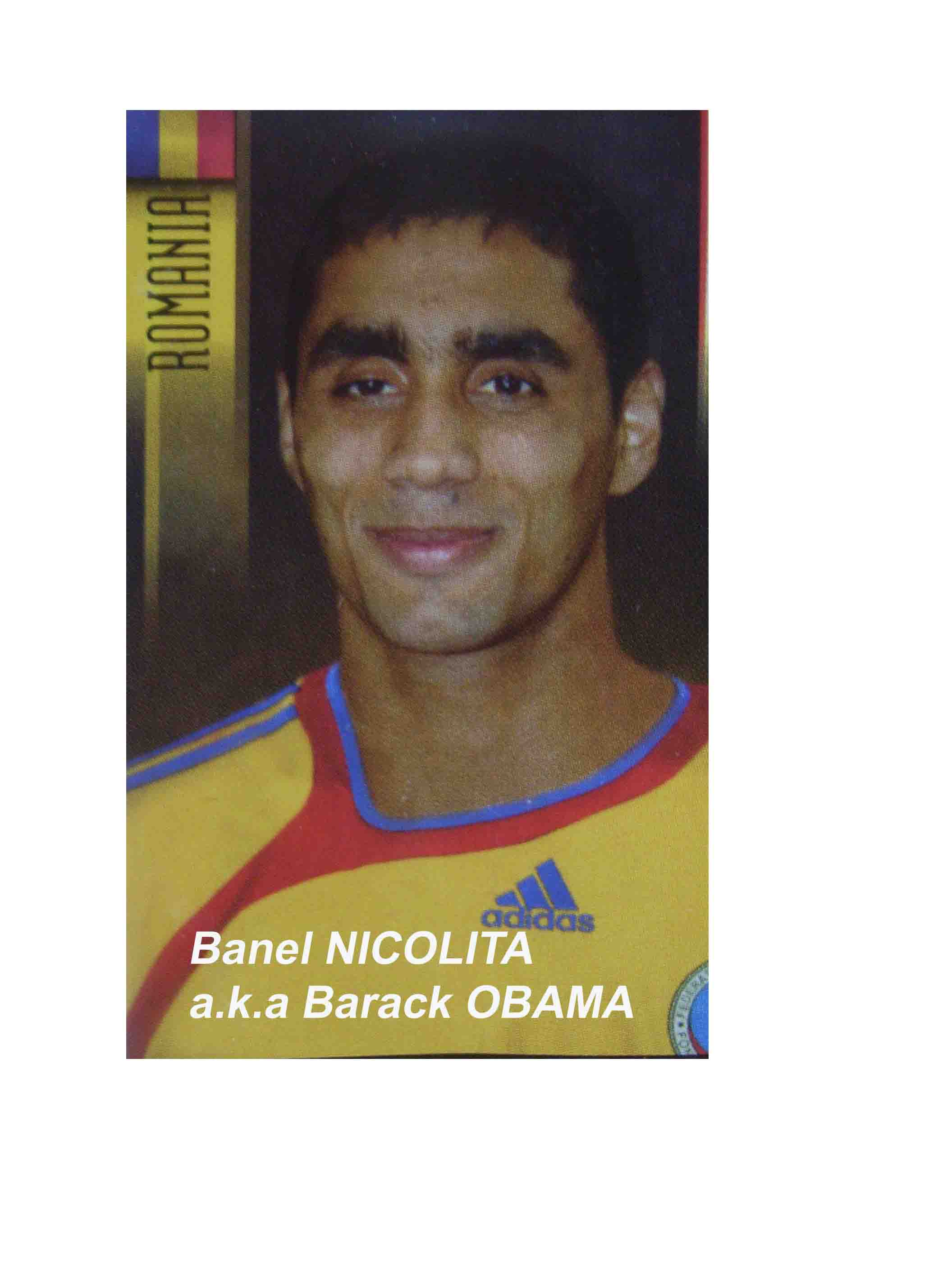
By the way, no one in the world calls the game soccer but the Americans. No one. It’s football!!!!
Sometimes it is necessary to re-arrange things. This led Clemens and me to open a new blog for professional purposes: KopfmaennchenConsult. This is the place where you find information about what we can offer to you. In turn, Kopfmaennchen now is – as it was some time – my privat-public space, where I will blog what I am interested in.
 kopfmaennchen