Archive for the 'Uncategorized' Category


Local Politics in a comparative Perspective – Petrozavodsk and Tuebingen

Most recently I have published an edited volume on Local Politics in a comparative perspective together with my collegue Elena Ivanovna Chernenkova from Petrozavodsk State University. It brings together case study and comparative articles on aspects of local politics in both cities that were intensly discussed in a workshop in October 2016 and are the groundwork for further cooperation.

  • Rolf Frankenberger & Elena Chernenkova (eds.): Local Politics in a Comparative Perspective – The Cases of Petrozavodsk and Tübingen. Baden-Baden: Nomos. 272 pp., ISBN 978-3-8487-3892-2

All Politics is local. This is at least what former Congressman and US Speaker of the House of Representatives Tip O’Neill is said to have stated referring to the principle that successful politicians have to stay connected to their constituency and to the problems, interests and opinions of their local electorate.[1] But, as Peter Allen and David Cutts ask, “what do we mean by local?”.[2] Can we reduce the term local to the rootedness of national politics in the grass of constituencies, communities, or municipalities? This might be one way to define it. One could also argue that even though all politics is local, local politics is where the people are. This shifts the focus of analysis away from the national level of the political system towards the regional or even local level of governance, government, politics and participation. There are manifold studies dealing with political phenomena on the local level in different disciplines from political science to public administration, from geography to ethnography, from economics to architecture. Even though probably addressing the same entities, the foci of interest slightly shift: Whereas Urban Studies[3] mainly focus on development and planning of cities, Local and Municipal Government Studies highlight the importance of public administrations and governmental institutions in local politics.[4] Local Governance Studies instead broaden the perspective of politics by including private, business and not-for business actors in their analysis of political decision making.[5] And there are also different perspectives on actors in local politics. Whereas some studies focus on political elites, others take a grassroots perspective on citizen government, civic participation, and social engagement.

Starting from the notion that local self-government is one of the core principles for the political organization of municipalities across Europe[6], this volume takes a slightly different perspective, that in a way combines several aspects of the fields of study mentioned above. Municipalities are the venue for citizens to directly experience politics, and they also constitute the playground for diverse actors from business, civil society, administration and politics in the political arena. Thus, one could argue that local politics work similarly irrespective of cultural, political and social environments, as they are driven by local needs and demands. This narrow perspective on local politics seems to be somewhat misleading, given the fact that the local political level of municipalities is embedded in multi-level governance arrangements and political institutions. And they are embedded in different settings of (political) culture and society.

If we then want to understand local politics, we should widen the perspective of analysis and treat regional belonging, institutional settings and multi-level governance at least as potential determinants of variation. As research-literature doing or dealing with inter- and cross-regional comparisons suggests, these systemic environments still do have impact on local self-government[7]: They might constrain political actors and shape political processes in very specific ways. Examining two cities – Petrozavodsk and Tübingen – in comparative case studies and from a comparative perspective, social scientists and practitioners in politics and civil society from both municipalities contributing to the volume analyze how local politics and political culture are shaped in multi-level governance, how state-society relations and civic participation work in different systemic settings.

The volume comprises six thematic sections, each focusing on a different aspect of local politics. Starting from more general theoretical and methodological issues in section I, we investigate in political culture, identity and public opinion in section II . The articles in section III deal with social innovation as a mechanism and driving force of change and development in municipalities. In sections IV, V, and VI we broaden the perspectives, starting from political participation in local politics, passing on to state-society relations and NGOs and ending up with international relations in local politics.

[1]     Cf. Gelman, Andrew 2011: All Politics is Local? The debate and the Graphs. FiveThrityEight, 03.01.2011. https://fivethirtyeight.blogs.nytimes.com/2011/01/03/all-politics-is-local-the-debate-and-the-graphs/ (01.08.2017).

[2]     Allen, Peter/Cutts, David 2014: All Politics is local – but what do we actually mean by local. Political Insight, 17.02.2014. https://www.psa.ac.uk/insight-plus/blog/all-politics-local-%E2%80%93-what-do-we -actually-mean-local (01.08.2017).

[3]     For an overview on Urban Studies cf. Paddison, Ronan (ed.) 2001: Handbook of Urban Studies, London.

[4]     For an overview on different aspects of local politics cf. Haider-Markel, Donald 2014: The Oxford Handbook of State and Local Government, Oxford; Baldersheim, Harald/Wollmann, Hellmut (eds.) 2006: The Comparative Study of Local Government and Politics: Overview and Synthesis, Leverkusen.

[5]     For trends and the shift from urban studies to urban governance studies, cf. McCann, Eugene 2017: Governing urbanism: Urban governance studies 1.0, 2.0 and beyond, in: Urban Studies 54 (2), pp. 312-326; Pierre, Jon 2005: Comparative Urban Governance-Uncovering Complex Causalities, in: Urban Affairs Review 40, pp. 446–462.  For shifts from Government to Governance, cf. Andrew, Caroline/Goldsmith, Michael 1998: From Local Government to Local Governance and beyond?, in: International Political Science review 19, pp. 101-117; John, Peter 2001: Local Governance in Western Europe, London. An overview on Governance: Bevir, Marc (ed.) 2010: The Sage handbook of governance, London.

[6]     Local self-government is codified in German Basic Law (Art. 28, 2.1) as well as in the Constitution of the Russian Federation (Art.12, 1+2). In addition, both countries have ratified the European Charter on Local Self-Government in 1988, and 1998 respectively.

[7]     Cf. Ahram, Ariel I. 2011: The theory and method of comparative area studies”, in: Qualitative Research 11(1), pp. 69-90; Basedau, Matthias/Köllner, Patrick 2007: Area studies, comparative area studies, and the study of politics: Context, substance, and methodological challenges, in: Zeitschrift für vergleichende Politikwissenschaft 1(1), pp. 105-124; Frankenberger, Rolf/Kiener, Isabel 2015: Kommunale Politik im Wandel: Petrosawodsk und Tübingen, Tübingen; Frankenberger, Rolf/Graf, Patricia 2013: Von Mangos und Pflaumen. Herausforderungen interregional vergleichender Fallstudien, Paper presented at the Conference „Politik, Region(en) und Kultur in der vergleichenden Politikwissenschaft“ der Sektion Vergleichende Politikwissenschaft der DVPW in Leipzig, 09.-11.10.2013.
Bürgerbeteiligung planen – Methodenhandbuch Bürgerbeteiligung

Bürgerbeteiligung gilt in der wissenschaftlichen Diskussion um die Krise der repräsentativen Demokratie als ein zentraler Schlüssel zur Revitalisierung der Demokratie. Darüber hinaus zeigen zahlreiche Untersuchungen, dass gut gemachte Bürgerbeteiligung die Zufriedenheit der Bürgerinnen und Bürger mit politischen Prozessen und Entscheidungen verbessert.

Um Beteiligungsprozesse planen, entwickeln und durchführen zu können, benötigt man ein fundiertes Wissen über Methoden der Bürgerbeteiligung. Dieses Jahr erschienen sind zwei Bände eines fünfbändigen„Methodenhandbuch Bürgerbeteiligung“, das im Kontext der Akademie für Lokale Demokratie e.V. (ALD) (www.lokale-demokratie.de) entwickelt wurde.

Den HerausgeberInnen Peter Patze-Diordiychuk, Jürgen Smettan, Paul Renner und Tanja Föhr ist es ein zentrales Anliegen, „den gesamten Beteiligungsprozess in den Blick zu nehmen, indem ein breites Set an Methoden vorgestellt wird, die von der Auftragsklärung bis zur Ergebnis- und Lerntransfersicherung reichen“ (Bd. 1,S. 18).

Band 1 stellt Methoden der Planung und Auftragsklärung vor, insbesondere der Erhebungs- und Analysetechniken. Band 2 (vgl. die Rezension) beschäftigt sich mit Beteiligungsformaten und stellt 20 Methoden vor. Die geplanten Bände 3 (Online-Beteiligungsverfahren), 4 (Werkzeuge zur Lern- und Transfersicherung) und 5 (Moderationstechniken) sind für die nächsten drei Jahre angekündigt.

Literatur

Peter Patze-Diordiychuk, Jürgen Smettan, Paul Renner, Tanja Föhr (Hrsg.): Beteiligungsprozesse erfolgreich planen. Methodenhandbuch Bürgerbeteiligung, Band 1: oekom Verlag (München) 2017. 205 Seiten. ISBN 978-3-86581-833-1. 34,95 EUR.

Peter Patze-Diordiychuk, Jürgen Smettan, Paul Renner, Tanja Föhr (Hrsg.): Passende Beteiligungsformate wählen. Methodenhandbuch Bürgerbeteiligung. Band 2. oekom Verlag (München) 2017. 364 Seiten. ISBN 978-3-86581-853-9. D: 34,95 EUR, A: 36,00 EUR.

Lesen Sie die vollständigen Rezensionen zu beiden Bänden bei Socialnet unter:


State Councillor for Civil Society and Participation nominates Scientific Advisory Board

The State Councillor for Civil Society and Participation, Baden-Württemberg, Gisela Erler, has nominated a scientific advisory board that shall accompany the process of further strengthening citizen participation in political processes.

Erler argues that during her work as State Councillor, she alway sought and found inspiriation in the social sciences and wants to intensify exchange and cooperation between science and politics. The advisory board will work on citizen participation, direct democracy, social cohesion, european integration and political and civic education.

170323_Wissenschaftlicher_Beirat_fuer_Zivilgesellschaft_und_Buergerbeteiligung_01

The advisory board consists of fifteen scholars from political science, communication science, management sciences and other social sciences. These are

  • Prof. Dr. Gabriele Abels, University of Tuebingen
  • Prof. Dr. André Bächtiger, University of Stuttgart
  •  Prof. Dr. Frank Brettschneider, University Hohenheim
  • Prof. Dr. Ulrich Eith, University of Freiburg / Studienhaus Wiesneck
  • Prof. Dr. Adalbert Evers, University of Heidelberg, CSI
  • Dr. Rolf Frankenberger, University of Tuebingen,
  • Prof. Dr. Manuela Glaab, University Koblenz-Landau,
  • Prof. Dr. Cordula Kropp, University of Stuttgart
  • Prof. Dr. Arne Pautsch, University of Applied Sciences – Public Administration and Finance Ludwigsburg
  • Prof. Dr. Paul-Stefan Roß, Baden-Wuerttemberg Cooperative State University Stuttgart
  • Prof. Dr. Roland Roth, University of Applied Sciences Magdeburg-Stendal, Centre for Corporate Citizenship Deutschland
  • Prof. Dr. Karen Schönwälder, Max Planck Institute for the Study of Religious and Ethnic Diversity
  • Dr. Uwe Serdült, Zentrum für Demokratie Aarau, Switzerland
  • Prof. Dr. Angelika Vetter, University of Stuttgart
  • Prof. Dr. Hans-Georg Wehling, University of Tübingen

On the way to Welfare 4.0?

How does digitalization influence contemporary welfare states? How do they adjust towards Welfare 4.0? We – a group of political scientists from Eberhard Karls University Tuebingen – adressed these and other questions in a study for the Friedrich Ebert Foundation.The study is now available online in German  (Auf dem Weg zu Wohlfahrt 4.0) and English (On the way to Welfare 4.0?)

We ecamined both the status of digitalization and its effects on the fields labor markets, health-care and innovation in seven European welfare states: Estonia, Francce, germany, Italy, Spain, Sweden and the UK.

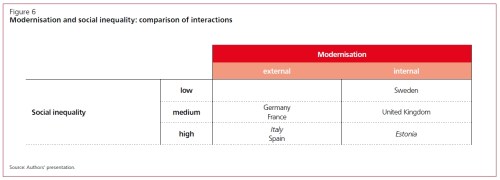
We especially focus on the influences of both, external and internal modernization effects of digitalization on the welfare architecture. External effects are induced by the transformation of industrial production (industry 4.0) into the welfare system, while internal effects are caused by the digitalization of the welfare state itself. Depending on the mode of modernization we can find different (potential) effects on the question of social inequality.

internal-vs-external-effects

Apparently, those countries do better in terms of equality who actively modernize their welfare state from within and who implement high standards of social welfare. The role model for this is Sweden.

For more results and insights, just download the study:

  • Daniel Buhr, Claudia Christ, Rolf Frankenberger, Marie-Christine Fregin, Josef Schmid & Markus Trämer (2016): Auf dem Weg zu Wohlfahrt 4.0? : Die Digitalisierung des Wohlfahrtsstaates in den Politikfeldern Arbeit, Gesundheit und Innovation im europäischen Vergleich.  Berlin:  FES,  ISBN 978-3-95861-687-5; DIGBIB-Permalink = http://www.fes.de/cgi-bin/gbv.cgi?id=13009&ty=pdf
  • Daniel Buhr, Claudia Christ, Rolf Frankenberger, Marie-Christine Fregin, Josef Schmid & Markus Trämer (2016): On the way to welfare 4.0? : Digitalisation of the welfare state in labour market, health care and innovation policy : a European comparison. Berlin: FES, ISBN 978-3-95861-712-4; DIGBIB-Permalink = http://www.fes.de/cgi-bin/gbv.cgi?id=13010&ty=pdf

In addition to the comparative study we also examined the seven welfare states in more comprehensive case studies:


Unlike Twins – Conference Program online.

In March 2017 the bi-annual conference of the DVPW Section “Comparative Politics” “Unlike Twins?! Comparing Democracies and Autocracies.” will take place in Tübingen.

Having received many excellent proposals for panels and papers, the panel convenors and the local organization team have compiled the conference program for March 2017. There will be 17 sessions with more than 70 presentations from internationally reknowned scholars of autocracy and democracy.

The conference will take place at the Eberhard Karls University Tübingen in the Rooms of the Theological Faculty, Theologicum, Liebermeisterstraße 12-18, D 72076 Tübingen from 15-17.March 2017.

You can either have a look at the short program as pdf-document or just scroll down for an overview of panels and presentations that deal with aspects of comparing autocracy and democracy:

Panel 1 – “Parliamentary Representation in Non-Democratic Regimes”

Chairs:    Katharina Buck, University of Bremen &  Esther Somfalvy, IFSH – Institute for Peace Research and Security Policy. Presentations by:

  • Anja Osei (University of Konstanz): “Glass Half Full or Half Empty? Government-Opposition Interaction in the Authoritarian Legislature of Togo”
  • Daniel Stockemer (University of Ottawa): “(Democratic) Regime Change and the Representation of Women in Parliament”
  • Irene Weipert-Fenner (PRIF – Peace Research Institute Frankfurt): “Detectorand Agent of Change: The Autocratic Parliament in Mubarak’s Egypt”
  • Esther Somfalvy (IFSH): “Do Different Kinds of Regimes Represent Their Citizens Differently? Evidence from the Parliaments of Kazakhstan and the Kyrgyz Republic”
  • Kristin Eichhorn (Technical University Chemnitz): “Electoral Competitiveness and Turnout in Autocracies”

Panel 2 – „Macht Religion politische Systeme autokratisch?“ (Double Panel)

Chairs:    Gert Pickel, Universität Leipzig & Oliver Hidalgo, Universität Münster. Presentations by:

  • Oliver Hidalgo (Münster): „Religion als ‚autoritäres‘ Gegengewicht zur Demokratie? Theoretische und ideengeschichtliche Zugänge“
  • Christoph Trinn & Thomas Wencker (Heidelberg): “No State is an Island: Inter-Regime Cooperation in Transnational ConflictsSusanne Pickel (Duisburg): “Gods Own Country: Religion, politische Religion oder Religiosität als Spoiler of Democracy?
  • Marlene Mauk (Mainz): „Macht Religion Menschen autokratisch?“
  • Gert Pickel (Leipzig): „Verhindert der Islam Demokratisierung? Perspektiven aus der Sicht der politischen Kulturforschung“Cemal Öztürk & Toralf Stark (Duisburg): „Das ‚türkische Modell‘ in der Krise: Sind religiöse Individuen in der Türkei ‚genuine Demokraten‘? Eine Überprüfung  der Kompatibilität von ‚Islam‘ und ‚Demokratie‘ auf Grundlage der politischen Kulturforschung“
  • Jörg Baudner (Osnabrück): “From Religious to Populist Party (and Back)?”
  • Ludger Viefhues-Bailey (Syracuse): “Religion for the Illiberal State: The Example of Religious Liberty Laws in the U.S.”
  • Julia Gerlach (Leipzig): „Wie der Tempelberg in Jerusalem: Heilige Orte und russischer Diskurs um die Annexion der Krim“
  • Fabian Poetke (München): „Politische Anreize zur religiösen Aneignung der liberalen Demokratie: Das Fallbeispiel westdeutscher Bildungspolitik 1945-1965“

Panel 3 – “Same, Same but Different? Comparing the International Promotion of Democracy and Autocracy”

Chairs:    Julia Leininger, DIE – German Development Institute & the German Research Network External Democracy Promotion & Anna Lührmann, V-Dem Institute at the University of Gothenburg, SWE. Presentations by:

  • Christoph H. Stefes & Betcy Jose (University of Colorado, Denver): “Contesting and Shaping International Norms: The Neglected Side of Autocracy Promotion”
  • Agnes Cornell (Aarhus University) & Anna Lührmann (University of Gothenburg): “The Role of Political Context in the Allocation of Democracy Aid”
  • Pavel Satra (Leuphana Universität, Lüneburg): “Autocracies’ Counterintuitive Delegation Preferences to International Human Rights Organizations”
  • Julia Bader (University of Amsterdam) & Christine Hackenesch (DIE – German Development Institute – DIE, Bonn): “What Drives Authoritarian Party to Party Interaction? The Chinese Communist Party and African Ruling Parties”
  • Tina Freyburg (University St. Gallen) & Julia Leininger (DIE – German Develop-ment Institute, Bonn): “Democracy Promotion Needs Democrats: How Societal Values Matter”

Panel 4 – “State Spending and Taxation in Democracies and Autocracies: Comparing Patterns of Resource Management“

Chairs:    Thomas Richter & Christian von Soest, beide GIGA – German Institute of Global and Area Studies, Hamburg. Presentations by

  • Christian von Haldenwang (DIE – German Development Institute, Bonn): “What Impact Does Political Regime Durability Have on Public Revenue Collection?” and “Does the political resource curse affect public finance? The vulnerability of tax revenue in resource-rich countries”
  • Ane Karoline Bak Foged (Aarhus University): “Taxation, Revenue Bargains and the Effect on Accountability Institutions in Developing Countries
  • Anne Mette Kjær & Marianne Ulriksen (Aarhus University): “The Unexplored Side of Fiscal Contract Theory: Revenue Bargains and Public Policy Provisions in Africa”
  • Thomas Richter (GIGA – German Institute of Global and Area Studies, Hamburg): “Taxation and the Formation of Political Institutions: An Explorative Analysis”
  • Rachel Beach (University of Aarhus): “Benin & Togo: the Unlike Twins of Revenue Mobilization in West Africa“
  • Solveig Richter (University of Erfurt): “Competing for Power and Money. State Capture and Limited Political Competition in Transition Countries”

Panel 5 – “Dimensions of Authoritarianism” (Double Panel), Intertional Aspects, Identity, State and Regime

Convenors & Chair:   Ahmad Maati & Oliver Schlumberger, University of Tübingen; Andreas Schedler (CIDE, Mexico City / University of Tübingen).Presentations by:

  • Marianne Kneuer, Thomas Demmelhuber, Tobias Zumbrägel, Raphael Peres-son Natalia Afanasyeva (University of Hildesheim & University of Erlangen): „Regional Organizations as Transmission Belt and Learning Room of Authoritarianism: Comparative Perspectives and Empirical Evidence”
  • Steven Heydemann (Smith College, Northampton): “Democracy Promotion, Institutions, and Authoritarian Resilience”
  • André Bank (GIGA – German Institute of Global and Area Studies, Hamburg): “Authoritarian Learning and Transnational Diffusion”
  • Morten Valbjørn (University of Aarhus): “What Is So Sectarian about Sectarian Politics? Identity Politics and Authoritarianism in a New Middle East”
  • Ahmad Maati (University of Tübingen): “Exclusivist Identity Formation, the State, and Authoritarianism“
  • Oliver Schlumberger (University of Tübingen): Authoritarian Resilience and the State in the Arab World“

Panel 6 – “Challenging the Churchill-Hypothesis Policy-Performance in Democracies and Autocracies in Comparison” (Double Panel)

Chair:       Stefan Wurster, Technical University Munich. Presentations by:

  • Henriette Müller (New York University, Abu Dhabi): “Understudied Parallels: Political Leadership and Economic Growth Across Regime Types”
  • Tobias Rommel (University of Zurich): “Political Regimes and Foreign Investment Liberalization”
  • Marlene Jugl (Hertie School of Governance, Berlin): “Small Is Democratic – or Monarchic? Population Size, Regime Type and State Performance”
  • Sebastian Stier (GESIS – Leibniz Institute for the Social Sciences): “Internet diffusion and Regime Type: Temporal Patterns in Technology Adoption“
  • Eda Keremoglu-Waibler (Universität Stuttgart): “Does Consultative Decision-Making Matter for Citizens’ Welfare in Authoritarian Regimes?”
  • Sebastian Ziaja (Research Center for Distributional Conflict and Globalization, Heidelberg University): “The Democratic Civil Peace Revisited: Assessing the Predictive Power of Political Regime Indicators”
  • Romy Escher & Melanie Walter-Rogg (Universität Regensburg): „Does the Choice of the Democracy Measure Matter in the Analysis of the Relationship between Democracy and Global Public Good Provision? The Case of Climate Policy Performance”
  • Aron Buzogány (BOKU Vienna, Institute of Forest, Environmental, and Natural Resources Policy): “Comparing Clean Energy Transitions over the Regime Divide”

Panel 7 – “Bridging Comparative Politics and Area Studies”

Chairs:    Patrick Köllner, GIGA – German Institute of Global and Area Studies / University of Hamburg  & Andreas Mehler, Arnold Bergsträsser Institute and University of Freiburg. Presentations by:

  • Patrick Köllner (GIGA, Hamburg), Ariel Ahram (Viriginia Tech), Rudra Sil (Uni-versity of Pennsylvania): “Comparative Area Studies: What It Is, What It Can Do?”
  • Christian von Soest (GIGA, Hamburg) & Alexander Stroh (University of Bayreuth): “Comparing across World Regions: Assets and Pitfalls”
  • André Bank (GIGA, Hamburg): “Comparative Area Studies and the Study of Middle East Politics after the Arab Uprisings”
  • Sophia Schubert (FU Berlin) & Alexander Weiß (HSU Hamburg): “Bridging Political Theory, Comparative Politics and Area Studies: A Plea for Global-transcultural Democracy Research”

Panel 8 – “Why Wrong Is Right: Justifying Exclusion and Repression in Autocracies and Democracies”

Chairs:    Maria Josua & Julia Grauvogel, GIGA – German Institute of Global and Area Studies, Hamburg. Presentations by:

  • Aurel Croissant, David Kuehn, Tanja Eschenauer (Heidelberg University): “The ‘Dictator’s Endgame’: Explaining Military Behavior in Nonviolent Anti-Incumbent Mass Protests”
  • Dag Tanneberg (University of Potsdam): “What is dead may never die … How Restrictions and Violence Defeat Direct Action Campaigns”
  • Jonas Wolff (PRIF – Peace Research Institute Frankfurt): “Justifying Civic Space Restrictions: Does Regime Type Matter?”
  • Holger Zapf (University of Göttingen): “Framing Protest: Delegitimizing Contention in Tunisia before and after 2011”
  • Ani Sarkissian (Michigan State University): “Defining ‘Normal’ Religion: How State Bureaus of Religion Help Governments Manage Opposition and Retain Political Power”

Panel 9 – “Disentangling the State-Regime Nexus” (Double Panel)

Chairs:    Thomas Altmeppen & Mirjam Edel, University of Tübingen Presentations by:

  • Thomas Altmeppen (University of Tübingen): “Blinded by the Light? Michael Mann and the Problem of Conceptual Confusion in the Study of States and Regimes”
  • Dan Slater and Christopher Haid (University of Chicago), Ferdinand Eibl (King’s College, London), and Steffen Hertog (LSE, London): “War Makes the Regime: Rebellion Type and the Origins of Authoritarian Regime Types”
  • Maya Tudor (Oxford University): “Disentangling States and Regime Sequencing in Postcolonial India and Pakistan”
  • Julia Leininger (DIE – German Development Institute, Bonn): “Eroding Democracy by Building the State: A Comparative Analysis of Mozambique”
  • Rachel Sigman, (V-Dem Institute at the University of Gothenburg): “State Capacity Types and Regime Outcomes”
  • David Anderson (Aarhus University): “Political Dilemmas in State-Building: Why Germany and Argentina Finally Settled for Democracy while Thai Democracy is Still Struggling“
  • Alexander Schmotz (King’s College, London): “Revolution Gone Awry: Popular Uprisings, Regime Breakdown, and State Failure“
  • Matilde Thorsen, Alexander Taaning Grundhold, and David Ulrichsen (Aarhus University): “Motivated and Able to Make a Difference for the Poor? The Compli-mentary Effects of Democracy and State Capacity in Promoting Human Develop-ment”

Panel 10 – “Welfare-Production-Regime Triangle: Comparing Welfare State and Capitalism in Democracies and Autocracies”.

Chairs:    Daniel Buhr & Markus Trämer, University of Tübingen. Presentations by:

  • Markus Trämer (University of Tübingen): “Which institutional complementarities underpin authoritarian economies and welfare systems? China, Vietnam and Laos”
  • Aline Grünwald (SOCIUM – Research Center on Inequality and Social Policy Bremen): “The historical roots of old age pension systems in democratic and nondemocratic regimes around the world”
  • Hans-Jürgen Bieling (University of Tübingen): “Varieties of Financialization – on the structure, role and mode of operation of finance in contemporary European capitalism”
  • N.N.

Panel 11–“Rule of Law vs. Rule by Law: How Do Autocracies & Democracies Govern?”

Chairs:    Mirjam Edel & Rolf Frankenberger, University of Tübingen. Presentations by:

  • Michael Hein (Humboldt Universität, Berlin): “The Codification of Constitutional Entrenchment Clauses in Democracies and Autocracies”
  • Jörn Knobloch (University of Potsdam): “Rule of Man Not Rule of Law: Practical Foundations of Authoritarian Regimes and the Impact of Law”
  • David Andersen & Agnes Cornell (Aarhus University):“Political Regime Dynamics and State Impartiality”
  • Mirjam Edel (University of Tübingen): “Which Role of Law? Conceptualizing Legal and Judicial Aspects of Political Repression”

 Panel 12 – “Concept Formation and Explorative Methods: What and How Can MethodsContribute to Regime Classification in Comparative Politics?

Chairs:    Toralf Stark, Universität Duisburg-Essen & Rolf Frankenberger, University of Tübingen. Presentations by:

  • Sebastian Ziaja (Heidelberg University) & Martin Elff (ZU Friedrichshafen)“Latent Dimensions, Latent Classes and Method Factors in Political Regime Data”
  • Seraphine F. Maerz (Central European University, Budapest): “The Conditions of Authoritarian Persistence: Classifying Autocratic Regimes by Applying Fuzzy-Set Qualitative Comparative Analysis”
  • Christoph Mohamad-Klotzbach & Oliver Schlenkrich (Universität Würzburg): “The State-Regime Nexus: A Political Culture-Perspective”
  • Ani Sarkissian (Michigan State University) & Karrie Koesel (University of Notre Dame): “Religion and the Authoritarian Toolkit”

Categories